
Arthur Oswald, COUNTRY LIFE, 21 September 1940
WORMINGTON GRANGE, GLOUCESTERSHIRE
THE SEAT OF MAJOR- GENERAL SIR HASTINGS ISMAY, K.C.B., D.S.O., AND LADY ISMAY
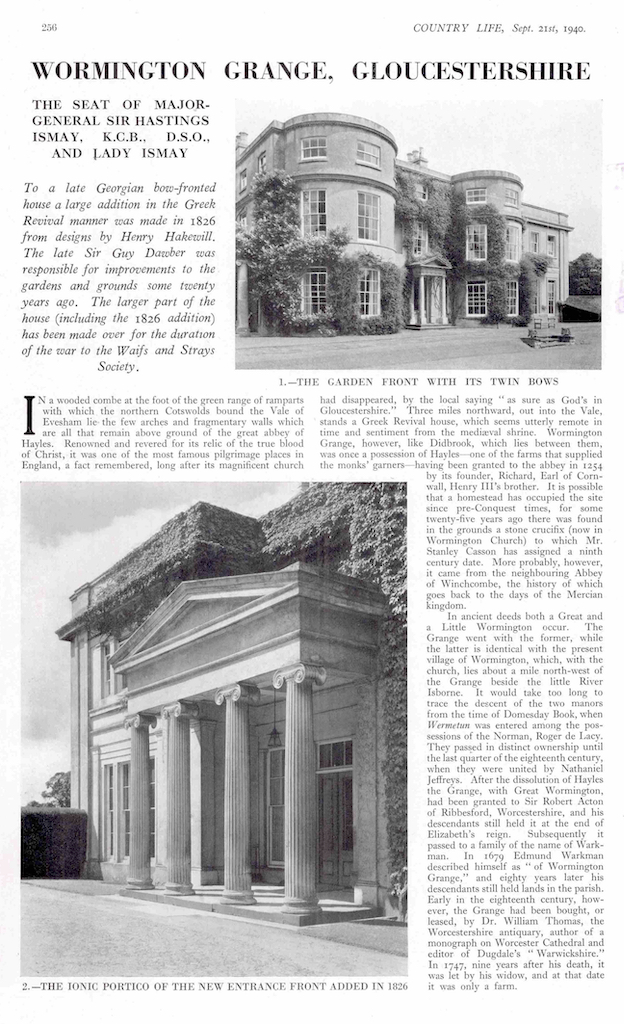
To a late Georgian bow-fronted house a large addition in the Greek Revival manner was made in 1826 from designs by Henry Hakewill. The late Sir Guy Dawber was responsible for improvements to the gardens and grounds some twenty years ago. The larger part of the house (including the 1826 addition) has been made over for the duration of the war to the Waifs and Strays Society.
IN a wooded combe at the foot of the green range of ramparts with which the northern Cotswolds bound the Vale of Evesham lie- the few arches and fragmentary walls which are all that remain above ground of the great abbey of Hayles. Renowned and revered for its relic of the true blood of Christ, it was one of the most famous pilgrimage places in England, a fact remembered, long after its magnificent churchhad disappeared, by the local saying “ as sure as God’s in Gloucestershire.” Three miles northward, out into the Yale, stands a Greek Revival house, which seems utterly remote in time and sentiment from the mediaeval shrine. Wormington Grange, however, like Didbrook, which lies between them, was once a possession of Hayles—one of the farms that supplied the monks’ garners—having been granted to the abbey in 1254 by its founder, Richard, Earl of Cornwall, Henry Ill’s brother. It is possible that a homestead has occupied the site since pre-Conquest times, for some twenty-five years ago there was found in the grounds a stone crucifix (now in Wormington Church) to which Mr. Stanley Casson has assigned a ninth century date. More probably, however, it came from the neighbouring Abbey of Winchcombe, the history of which goes back to the days of the Mercian kingdom.
In ancient deeds both a Great and a Little Wormington occur. The Grange went with the former, while the latter is identical with the present village of Wormington, which, with the church, lies about a mile north-west of the Grange beside the little River Isborne. It would take too long to trace the descent of the two manors from the time of Domesday Book, when Wermetun was entered among the possessions of the Norman, Roger de Lacy. They passed in distinct ownership until the last quarter of the eighteenth century, when they were united by Nathaniel Jeffreys. After the dissolution of Hayles the Grange, with Great Wormington, had been granted to Sir Robert Acton of Ribbesford, Worcestershire, and his descendants still held it at the end of Elizabeth’s reign. Subsequently it passed to a family of the name of Warkman. In 1679 Edmund Warkman described himself as “ of Wormington Grange,” and eighty years later his descendants still held lands in the parish. Early in the eighteenth century, however, the Grange had been bought, or leased, by Dr. William Thomas, the Worcestershire antiquary, author of a monograph on Worcester Cathedral and editor of Dugdale’s “ Warwickshire.” In 1747, nine years after his death, it was let by his widow, and at that date it was only a farm.